
Scuba Theory: What Your Open Water Study Covers
Understand why knowledge development is part of a practical diving qualification, rather than an optional extra.
By Copperband Scuba Academy
On this page
Connect the principles to the equipment
Study introduces the relationship between pressure, breathing gas and buoyancy. It helps explain why equipment is used in particular ways and why the procedures matter. PADI’s learning programme provides the detail and assessments needed for the course.
Connect planning to your skills
You learn to plan and monitor a dive, communicate with a buddy and respond using the procedures taught in training. Pool practice develops skills before you use them in open water. A summary article cannot replace either stage.
Prepare before arriving in Pattaya
Contact Copperband about your study and course arrangements before travel. The advertised Open Water programme normally runs over three days at THB 14,500, with completion dependent on meeting the training requirements. Allow enough time for both learning and practice.
Theory gives the practical skills a reason
Open Water study introduces equipment, pressure, buoyancy, planning and the buddy system. The purpose is to understand why divers prepare and behave in particular ways. A definition that seems abstract during study often becomes easier to understand when the instructor connects it with a pool exercise or a boat briefing.
Pressure affects gas spaces as depth changes, which helps explain why breathing, buoyancy and controlled movement are taught carefully. Planning topics explain why you monitor the dive rather than decide everything by how the site looks. Equipment learning helps you understand the information and controls available to you.
Use questions and knowledge reviews to identify gaps before practical training adds more tasks. If a concept is unclear, tell the instructor instead of memorising an answer only to pass a quiz. Understanding is useful after certification, when you meet a different site or equipment setup.
Build study time into the course holiday
Discuss PADI study arrangements with Copperband before your practical dates. Completing preparation in advance can make the in-person sessions easier to focus on, but the instructor still needs to check knowledge and performance. Online study alone is not the same as completing the certification programme.
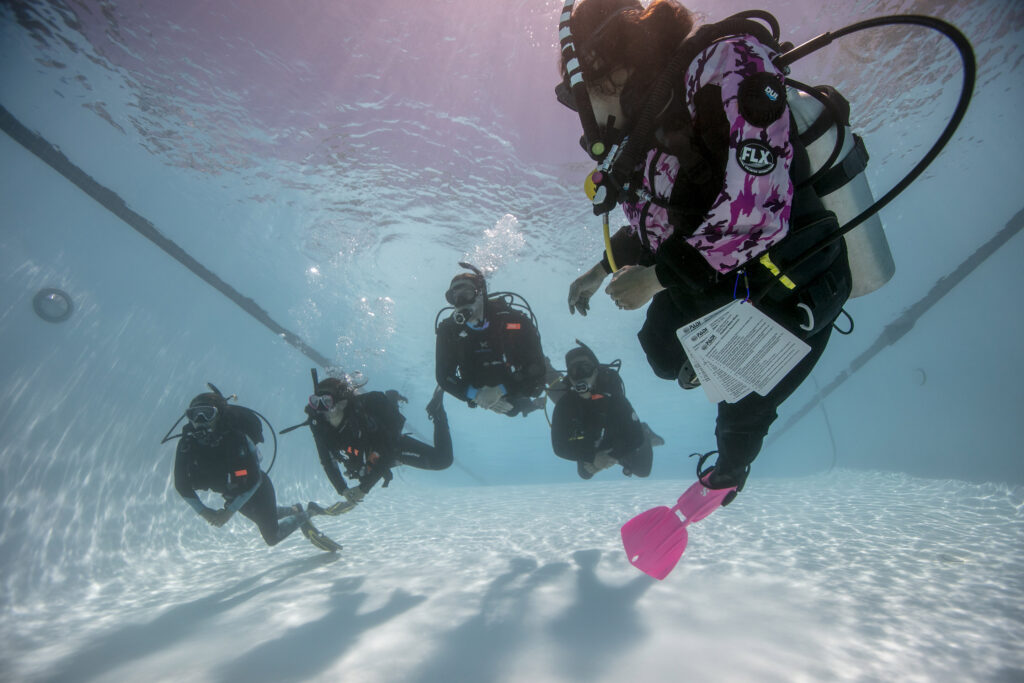
The pool and four open water training dives give you opportunities to use what you studied. Listen to the explanation, practise the skills and connect the feedback with the underlying concept. The training sequence is designed to bring knowledge and action together.
Allow enough time for learning rather than treating the course as a holiday attraction with a fixed finishing time regardless of progress. Certification follows successful completion of the requirements. If your travel dates are tight, explain them when booking so a realistic programme can be discussed.
Plan your next step
Read the relevant trip or course page for the current price, inclusions and booking arrangements. Contact the Copperband team with your experience and preferred dates before deciding on training or a specialist trip.
Explore Open WaterFurther reading: PADI’s basic scuba principles and PADI’s introduction to diving physics.
A common question
Does completing eLearning finish my Open Water certification?
No. Knowledge study is one part of the programme. Practical training and assessment are also required, including the controlled-water work and open water training dives.
Further reading from official resources
These resources explain the training or diving-health topics discussed here. Your instructor checks the requirements and arrangements for your programme.
Frequently asked questions
What topics are included in scuba diving theory?
Beginner scuba theory covers diving equipment, pressure and gas spaces, buoyancy, breathing gas, dive planning, the buddy system, underwater communication and recognising problems. PADI eLearning provides the knowledge development; instructor-led pool practice and four open water training dives put it into use.
How do gas laws relate to scuba diving?
Pressure increases as you descend and gas spaces compress; on ascent, gas expands as pressure decreases. Boyle’s law describes the pressure–volume relationship at constant temperature. These principles help explain buoyancy changes and the need for equalisation and controlled ascent. Study the complete procedures with your instructor rather than using a short article as a diving plan. Read PADI’s diving physics guide.