

🧭 Introduction: Where Adventure Meets Science
Scuba diving is often celebrated for its breathtaking beauty, serene silence, and thrilling exploration. But beneath the surface—literally and figuratively—lies a world governed by the laws of physics. Whether you’re gliding past coral reefs in Pattaya or descending into the depths of a sunken wreck, your every movement is dictated by principles laid down centuries ago by Archimedes and Isaac Newton.
In this blog, we’ll explore:
- The fundamentals of scuba diving in Pattaya, Thailand 🌴
- How Archimedes’ Principle explains buoyancy underwater ⚖️
- The role of Newton’s Laws in diving dynamics 🚀
- Practical applications for divers and instructors 🧠
🐠 Scuba Diving in Pattaya: A Tropical Gateway to the Deep
Pattaya, located on Thailand’s eastern Gulf coast, is a premier destination for scuba diving. With year-round diving conditions, vibrant marine life, and iconic wrecks like the HTMS Khram and Hardeep, Pattaya offers something for every diver—from beginners to seasoned pros.
🌟 Highlights of Pattaya Diving
- Wreck Diving: Explore sunken ships teeming with marine life.
- Coral Reefs: Encounter batfish, barracuda, and hawksbill turtles.
- Dive Schools: PADI-certified centers like Copperband Scuba Academy offer courses from beginner to Divemaster all the way then to Instructor.
- Accessibility: Just 2 hours from Bangkok, Pattaya is ideal for weekend dive trips.
⚖️ Archimedes’ Principle: The Science of Staying Afloat
Archimedes’ Principle states:
“Any object submerged in a fluid experiences an upward buoyant force equal to the weight of the fluid it displaces.”
🧪 Application in Scuba Diving
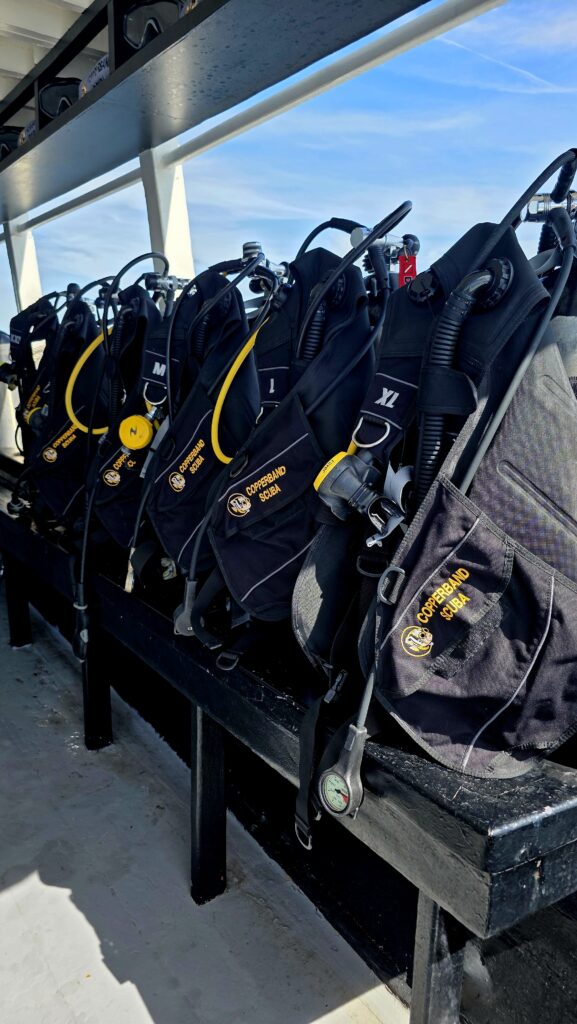
- Buoyancy Control: Divers use Buoyancy Control Devices (BCDs) to adjust their volume and displace more or less water, thereby controlling ascent and descent.
- Neutral Buoyancy: Achieved when the diver’s weight equals the buoyant force. This allows for effortless hovering—crucial for Scuba Diving as well as reef conservation and photography.
- Weight Systems: Divers wear lead weights to counteract the buoyancy of wetsuits and air tanks.
🧠 Real-World Tip
Before diving in Pattaya’s coral gardens, mastering buoyancy is essential. Poor control can damage fragile ecosystems and increase air consumption. We offer the PADI Peak Performance Buoyancy Specialty for those looking to work on their buoyancy skills and trim to become a sleek professional looking scuba diver.
🚀 Newton’s Laws of Motion: Underwater Dynamics Explained
Isaac Newton’s three laws of motion are equally vital in understanding how divers move and interact with the underwater environment.
1️⃣ Newton’s First Law: Inertia
“An object in motion stays in motion unless acted upon by an external force.”
- Underwater Glide: Once a diver kicks, they continue moving until drag slows them down.
- Streamlining: Reducing surface area minimizes drag, conserving energy.
2️⃣ Newton’s Second Law: F = ma
“Force equals mass times acceleration.”
- Fin Kicks: The force exerted by fins propels the diver forward. Stronger kicks = faster movement.
- Tank Weight: Heavier gear requires more force to maneuver, affecting agility.
3️⃣ Newton’s Third Law: Action-Reaction
“For every action, there is an equal and opposite reaction.”
- Air Release: Letting air out of the BCD causes the diver to descend.
- Exhalation: Breathing out slightly reduces buoyancy, aiding in fine-tuned depth control.
🧭 Dive Planning in Pattaya: Physics Meets Practice
Combining physics with local knowledge enhances safety and enjoyment.
📍 Dive Sites to Apply Your Skills
| Dive Site | Depth Range | Ideal For | Physics Focus |
| HTMS Khram | 15–30m | Advanced Divers | Buoyancy, Inertia |
| Hardeep Wreck | 25–30m | Wreck Enthusiasts | Action-Reaction |
| Koh Sak & Koh Krok | 5–15m | Beginners | Neutral Buoyancy |
🧠 Safety Tips
- Pre-Dive Buoyancy Check: Test your BCD and weights before descent.
- Controlled Ascents: Use Newton’s laws to understand how rapid ascents can lead to decompression sickness.
- Trim and Streamline: Reduce drag to conserve energy and air.
🧪 Boyle’s Law: The Invisible Force Shaping Every Dive
Boyle’s Law is a cornerstone of scuba diving physics. Formulated by Robert Boyle in the 17th century, it states:
“At a constant temperature, the pressure of a gas is inversely proportional to its volume.” Mathematically: P × V = constant
🌊 What This Means Underwater
As a diver descends, the pressure increases, causing the volume of air in flexible spaces—like the lungs, mask, and BCD—to decrease. Conversely, as the diver ascends and pressure decreases, the volume of air expands.
📌 Real-Life Applications in Scuba Diving
- Ear Equalization: As pressure increases during descent, the air in the middle ear compresses. Divers must equalize to prevent barotrauma.
- BCD Inflation: On ascent, the air in the BCD expands. Divers must release air to maintain neutral buoyancy and avoid uncontrolled ascents.
- Lung Safety: The golden rule—never hold your breath while ascending—is rooted in Boyle’s Law. Holding your breath can cause the expanding air to rupture lung tissue, leading to serious injury.
🧠 Dive Tip
When diving in Pattaya’s deeper wrecks like HTMS Hardeep, understanding Boyle’s Law is critical. These sites often require precise buoyancy control and slow ascents to avoid decompression sickness and lung overexpansion injuries.
🔄 Integrating Boyle’s Law with Archimedes and Newton
Let’s tie it all together:
| Physics Law | Diving Application | Example in Pattaya |
| Archimedes’ Principle | Buoyancy control via BCD and weights | Hovering over coral reefs |
| Newton’s Laws | Movement and propulsion underwater | Fin kicks around wrecks |
| Boyle’s Law | Gas compression and expansion with depth | Ascending from HTMS Khram |
Each law plays a vital role in dive safety, efficiency, and enjoyment. Mastering them transforms you from a recreational diver into a thoughtful explorer of the underwater world.
🧭 Final Thoughts: Physics Is Your Dive Buddy
Scuba diving in Pattaya is more than just a tropical escape—it’s a living laboratory where centuries-old physics laws come to life. From the buoyant lift of Archimedes to the dynamic motion of Newton and the pressure-volume dance of Boyle, every dive is a symphony of science.
So next time you strap on your tank and descend into the Gulf of Thailand, remember: you’re not just diving into water—you’re diving into physics.
🌅 Conclusion: Dive Deeper—In Water and Wisdom
Scuba diving isn’t just a sport—it’s a symphony of science and sensation. In Pattaya, where turquoise waters meet rusted wrecks and coral kingdoms, understanding the physics behind your dive elevates the experience from thrilling to transformative.
So next time you descend into the blue, remember: Archimedes and Newton are diving with you.